

Cold room condensation is one of those problems that starts small and stays invisible until it isn’t. A little moisture on the door frame. A dusting of frost around the seal. A faint smell near the base of the unit. By the time it becomes obvious, it has usually been building for weeks, and in a commercial setting, it rarely stops at an inconvenience.
For refrigeration engineers and facilities managers responsible for cold rooms at scale, condensation is not a weather problem or a building problem. It is, in most cases, a door-management and sealing problem, which means it is largely preventable.
This guide explains why cold rooms condense, what the commercial consequences are when it goes unmanaged, and what a structured prevention approach looks like in practice.
Why do commercial cold rooms get condensation?
Condensation forms when warm, moisture-laden air comes into contact with a cold surface. In a cold room, those cold surfaces are everywhere: walls, ceilings, evaporator coils, door frames, and gaskets. Whenever the surface temperature drops below the dew point of the surrounding air, moisture condenses.
In a commercial cold room, the triggers are more frequent and more intense than in a domestic setting. The main causes are:
Warm air infiltration through the door
Every time a cold room door opens, warm humid air from the surrounding environment floods in. In a busy kitchen or food production facility, that can happen dozens or hundreds of times per shift. Each event deposits moisture inside the unit.
Worn or damaged door seals
A gasket that has cracked, compressed, or pulled away from the door frame allows a continuous, slow exchange of air even when the door is closed. The cold room works harder to compensate; surfaces get colder relative to the ambient air, and condensation accumulates steadily.
Missing or inadequate door curtains

In high-traffic cold rooms where a solid door is impractical, leaving the opening unprotected allows warm air to enter on every pass. Without a PVC curtain barrier, there is no buffer between the cold room environment and the ambient space.
Defrost cycle humidity
Commercial cold rooms run automated defrost cycles to prevent ice build-up on evaporator coils. During a defrost cycle, the evaporator heats up, releasing moisture into the interior air. If door sealing is already compromised, this compounds the problem.
Temperature differentials in high-summer or high-humidity environments
The greater the temperature difference between the internal cold room and the ambient air, the more aggressive condensation becomes. This is why problems often worsen in summer months or in high-humidity kitchens.
Understanding which of these is the dominant driver in any given installation is the starting point for an effective prevention strategy.
How does door management drive condensation in cold rooms?
The door is the single most controllable variable in cold room condensation. It is also, in most commercial operations, the most neglected one.
A solid cold room door in good condition with a properly fitted gasket forms an airtight, thermally broken barrier. When that barrier is intact, warm air infiltration between openings drops to near zero. When it degrades, whether through seal wear, frame misalignment, or door discipline, every closed-door moment becomes a slow leak.
In practice, door management failures fall into three categories.
Seal degradation over time
EPDM rubber gaskets, the standard for most commercial cold room doors, are designed for continuous use in demanding environments. They compress and mould to the door frame on every closure, forming a tight seal even on imperfect surfaces. But heavy use, cleaning chemicals, heat exposure, and physical damage all shorten their working life. A gasket that feels firm may already be failing at the corners or along the base, the points of highest wear.
Door frequency in high-traffic operations
A cold room serving a busy kitchen or food production line may be accessed many times per hour. Each opening is a warm-air event. Without a secondary barrier, a PVC strip curtain across the opening, every access allows a full exchange of ambient and cold air. The refrigeration system responds by working harder, which further lowers surface temperatures and accelerates condensation on walls and coils.
Frame and hinge alignment
A door that does not close squarely against the frame cannot compress the gasket evenly. Even a well-maintained seal performs poorly on a misaligned door. This is a common and easily missed cause of persistent condensation, particularly in older installations or units that have taken impact damage.
The argument for regular door and seal inspection is straightforward: the door is the primary point of thermal failure in any cold room, and most condensation problems trace back to it.
What are the signs that condensation is becoming a serious problem?
Early-stage condensation in a cold room is easy to overlook, particularly in busy operations where staff are focused on throughput rather than equipment condition. These are the indicators that a problem is developing and requires attention.
Frost or ice accumulation around the door frame or gasket
Frost at the door perimeter is a reliable indicator of warm air infiltration. It means moist air is entering and freezing on contact with the cold frame, a clear sign the door seal is not performing.
Ice build-up on evaporator coils beyond normal defrost cycles.
Excessive icing on the evaporator is a downstream consequence of elevated humidity inside the unit. If the coils are icing between defrost cycles, moisture is getting in from somewhere.
Condensation or water pooling on the floor inside or immediately outside the door
Water on the floor near the entrance is both a safety hazard and a symptom. Inside the unit, it points to humidity infiltration. Outside, it often indicates the door seal is allowing cold air to bleed out at the base.
Mould or discolouration on door frames, gaskets, or wall panels
Mould growth around the door seal is a direct consequence of persistent moisture and is a standard trigger point for Environmental Health Officers during inspections. A split, dirty, or mould-affected gasket signals both a hygiene risk and a temperature control failure.
Rising energy consumption without an obvious cause
When condensation is ongoing, the refrigeration system runs longer and harder to maintain target temperatures. If energy bills are climbing and no mechanical fault has been identified, the door and seal condition could be causing energy waste and should be the first investigation.
Temperature drift above target

Persistent warm air infiltration gradually raises the average temperature inside the cold room. If logs are showing drift beyond recommended temperature ranges that cannot be explained by loading or defrost cycles, sealing is the likely cause.
Any one of these signs warrants a prompt inspection. In combination, they indicate a problem that has been developing for some time and needs structured remediation rather than a quick fix.
What does unmanaged cold room condensation actually cost a business?
The operational cost of cold room condensation is rarely captured in a single line. It accumulates across energy, maintenance, stock, and compliance, which is precisely why it tends to be underestimated until a significant event forces it into view.
Energy waste
A cold room with compromised door sealing or no curtain protection works continuously against warm air infiltration. The refrigeration compressor runs longer and harder to maintain target temperatures.
Effective strip curtain installation can reduce cold air loss by 30–70%, depending on traffic levels and installation quality, and the compressor hours saved translate directly into energy cost reduction.
Accelerated component wear
A compressor running above its designed duty cycle wears faster. Evaporator coils icing between defrost cycles require more frequent defrost intervention. These are not theoretical consequences; they are the standard failure pathway for cold rooms with unmanaged door sealing problems. Compressor replacement is consistently the most expensive single repair in commercial refrigeration.
Stock loss and food safety risk
Temperature drift caused by warm air infiltration puts perishable stock at risk. Even a modest and persistent rise above safe storage limits accelerates bacterial growth and reduces shelf life. In a high-volume operation, the cumulative stock loss from a single underperforming cold room can be significant.
HACCP and regulatory compliance
Food businesses operating under HACCP principles are required to demonstrate that critical control points, including cold storage temperatures, are maintained. Persistent temperature drift due to condensation and seal failure is a HACCP failure, not merely an operational inconvenience.
Environmental Health Officers routinely inspect the physical condition of door gaskets during visits, and a mould-affected, split, or poorly fitted seal is a standard cause of inspection failure.
Hygiene ratings and reputational risk
In the UK, food hygiene ratings are published publicly. An inspection that identifies cold room door seals as a hygiene or temperature control concern contributes directly to a lower rating. For food businesses where reputation is commercial currency, this is not a marginal consideration.
The cost argument for proactive condensation management is not complicated: the interventions are inexpensive relative to the consequences of inaction, and most of the risk is concentrated in components, seals and curtains, that are straightforward to inspect and replace.
How do door seals prevent condensation in cold rooms?
The door gasket is the primary thermal and moisture barrier on any cold room door. When it is performing correctly, it eliminates the slow continuous air exchange that drives condensation accumulation between door openings.
For commercial cold rooms and cold store freezers, EPDM rubber gaskets are the industry standard. EPDM (Ethylene Propylene Diene Monomer) is a synthetic rubber chosen for its low-temperature flexibility, compression recovery, and durability in the demanding conditions of commercial refrigeration, wide temperature swings, frequent cleaning, and constant mechanical use.
A well-fitted EPDM gasket compresses evenly against the door frame on every closure, forming an airtight seal even where the surface is not perfectly even. This compression behaviour is what distinguishes rubber gaskets from other profile types: they accommodate minor misalignments and surface irregularities that would leave harder materials with gaps.
Gasket condition matters as much as gasket type. A rubber profile that has hardened, cracked at the corners, or pulled away from its retainer channel no longer compresses correctly. It may appear intact but still allow continuous air exchange, the kind that drives overnight condensation without any single obvious entry point.
Key indicators that a cold room gasket needs replacement include visible cracking or splitting, compression failure (the seal does not spring back after being pressed), mould growth on or behind the seal, frost formation at the door perimeter, and persistent temperature readings above target despite no mechanical fault.
Bespoke rubber gaskets for cold rooms and cold store freezers are measured and supplied by the metre, manufactured to OEM profile standards. For cold rooms with non-standard or unusual door configurations, bespoke profiles matched to the existing cross-section ensure the replacement seal performs as well as, or better than, the original.
How do PVC strip curtains reduce cold room condensation?
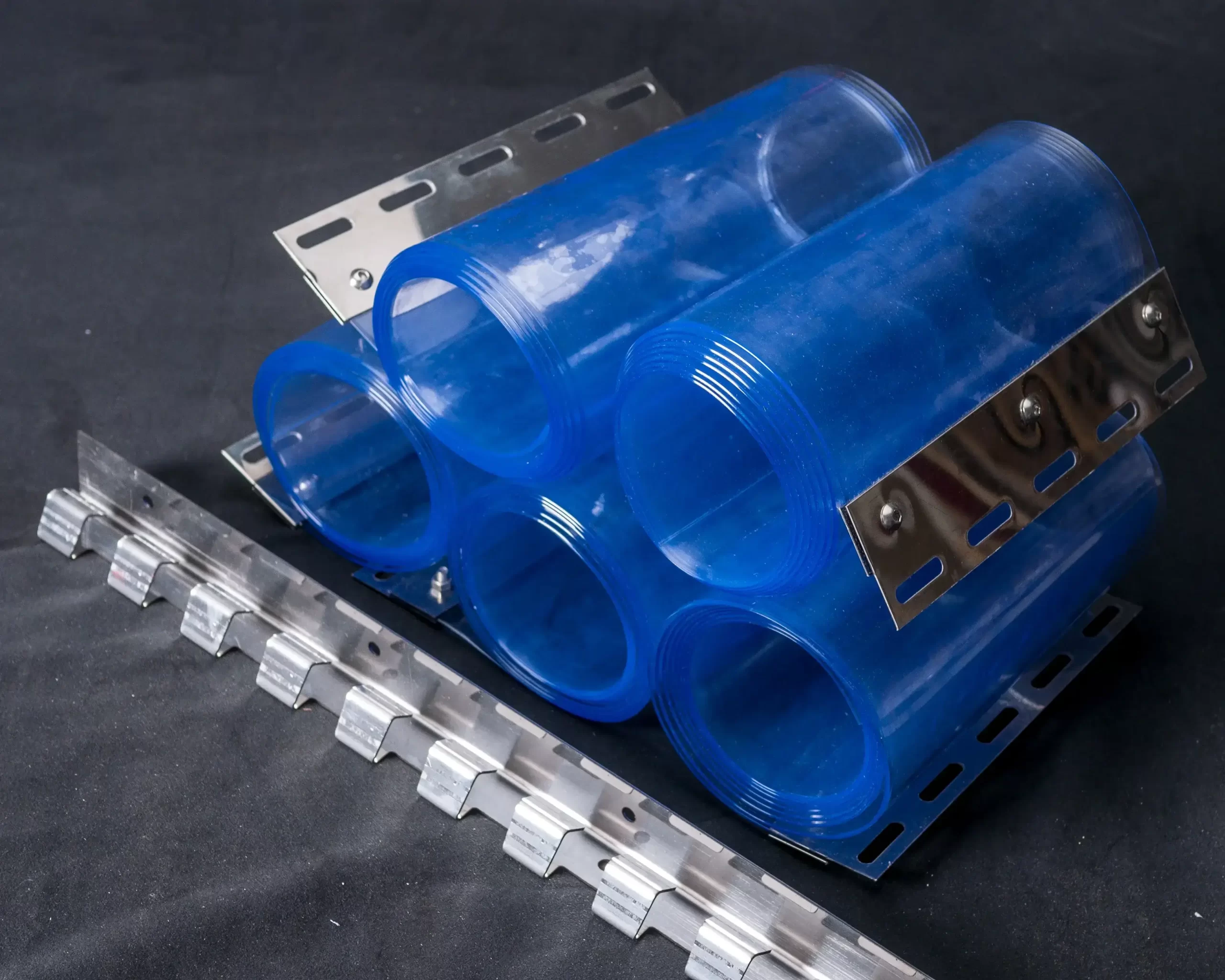
Where door seals manage the closed-door seal, PVC strip curtains address the open-door problem: the warm-air infiltration that occurs every time someone enters or exits the cold room.
In high-traffic cold rooms, this is where most humidity gain occurs. A cold room accessed frequently throughout a shift accumulates moisture with every opening. Without a secondary barrier, the refrigeration system is in a continuous recovery cycle, and condensation on walls, coils, and surfaces builds steadily.
PVC strip curtains work by maintaining a flexible barrier across the opening even during access. The overlapping strips allow people and equipment to pass through freely while significantly limiting the volume of warm air that enters on each transit.
The Seal Company’s curtain systems are designed with a 25% overlap between strips, this overlap provides the thermal separation; a curtain without adequate overlap performs significantly worse.
For a full guide to installation and getting the most from your curtain system, see PVC strip curtain installation and benefits.
Choosing the right grade matters
Standard Grade PVC strip curtains remain flexible and crack-resistant down to -15°C, making them the right choice for walk-in refrigeration cold rooms and coolers operating in the typical range of 0°C to -10°C. Polar Grade curtains are engineered for flexibility down to -25°C, essential for walk-in freezers and blast freezers where standard PVC becomes brittle and fails to overlap correctly, creating gaps rather than preventing them.
Using a Standard Grade curtain on a freezer application is a common installation error that effectively removes the thermal barrier at the temperatures where it is needed most.
Installation quality affects performance directly
A curtain that is too short, incorrectly spaced, or mounted without a proper head rail will not achieve the 30–70% cold air loss reduction that correctly installed curtain systems deliver.
Cold room door kits include a stainless steel hook-on head rail as standard. This ensures the curtain hangs at the correct height and position relative to the door opening, and allows individual strips to be replaced without removing the full installation.
For cold rooms where the access configuration makes a full curtain kit impractical, individual replacement strips, 200mm wide, 2050mm drop, with stainless steel hook-on plates, allow targeted maintenance of the curtain barrier without full replacement.
Standard Grade and Polar Grade Cold Room Door Kits are available for standard door configurations, with custom sizing for non-standard openings.
A practical cold room condensation prevention checklist
Condensation prevention in a commercial cold room is not a single intervention; it is a maintenance discipline. The following checklist covers the key inspection and action points for facilities managers and refrigeration engineers managing cold room performance.
Door seal condition
- Inspect rubber gaskets for cracking, splitting, or hardening, particularly at corners and along the base
- Press the seal and check for compression recovery; a gasket that does not spring back is no longer sealing correctly
- Check for mould growth on or behind the gasket. This indicates persistent moisture and should trigger immediate replacement
- Look for frost formation at the door perimeter when the unit is running. This confirms warm air infiltration
Door frame and alignment
- Check that the door closes squarely against the frame with even pressure around the full perimeter
- Inspect hinges for wear or misalignment, a door that drops or catches is not compressing the gasket evenly
- Ensure the door closer mechanism (where fitted) is functioning and pulling the door to a full close
PVC strip curtain condition and installation
- Check that all strips are present and undamaged; a single missing or torn strip creates a significant gap in the thermal barrier
- Verify that the 25% overlap between strips is maintained; strips that have shifted or been pushed aside reduce effectiveness
- Confirm the head rail is securely mounted and the curtain hangs at the correct height relative to the door opening
- Check that the correct grade is installed, Standard Grade (to -15°C) for refrigeration cold rooms, Polar Grade (to -25°C) for freezer applications
Temperature and humidity monitoring
- Review temperature logs for drift above target, persistent drift without a mechanical fault points to door sealing failure
- Check evaporator coils for ice build-up between scheduled defrost cycles
- Monitor energy consumption; a rising baseline without increased load is an early indicator of compressor overwork
- Check target temperatures are correctly set and understood by staff – see our guides to what temperature a fridge should be and what temperature a freezer should be for reference.
Housekeeping and staff practice
- Ensure staff are not propping cold room doors open, even brief propping during busy periods significantly increases warm air infiltration
- Check that the stock loading is not blocking the door from closing fully
- Clean door seals and curtain strips regularly, grime on gaskets prevents full compression; dirty curtain strips lose flexibility over time
Inspection readiness
- Keep records of gasket inspection and replacement dates for each cold room unit
- Document temperature logs in a format that supports HACCP review
- Ensure gasket condition is included in pre-inspection checks. EHOs routinely inspect door seal condition and mould around frames
Need help with a cold room condensation problem?
If you’re dealing with persistent condensation, frost build-up, or temperature instability in a commercial cold room, or if you manage cold rooms across multiple sites and want to get ahead of the problem, our team can help you identify the right sealing and curtain solution for your specific setup.
Get in touch with the team at The Seal Company for expert advice on cold room door gaskets, PVC strip curtains, and bespoke sealing solutions.