EPDM is a commonly used rubber in commercial refrigeration door seals and cold room gaskets, but the material is not always well understood. Is it actually rubber? How does it differ from other types of rubber? And when does it make sense to use something else?
This guide answers those questions directly. It covers what EPDM is, the properties that make it the standard choice for cold room and commercial refrigeration sealing, how it compares to alternatives such as silicone and Viton, and where its limitations lie.
Is EPDM actually rubber?
Yes. EPDM is a synthetic rubber, as opposed to a plastic. EPDM stands for Ethylene Propylene Diene Monomer, and it belongs to the elastomer family: materials that deform under stress and return to their original shape when that stress is removed. That elastic recovery behaviour is what makes it useful as a door seal.
The distinction between ‘natural’ and ‘synthetic’ rubber sometimes causes confusion. Natural rubber is derived from the latex of rubber trees. Synthetic rubbers such as EPDM are manufactured from petrochemical feedstocks and engineered to specific performance profiles. Both are genuinely rubber in the material science sense: elastomers with similar mechanical behaviour. However, they have different chemical structures and different strengths.
EPDM is produced by combining three monomers (ethylene, propylene, and a diene component) through polymerisation. The result is a material with a saturated polymer backbone, meaning there are very few reactive sites along the molecular chain. That stability is the source of EPDM’s resistance to oxidation, ozone, UV, and environmental degradation.
What is the difference between rubber and EPDM rubber?
‘Rubber’ is a broad category. EPDM is a specific type of rubber within that category. The distinction matters when you are selecting a door seal material, because different rubbers have quite different performance profiles.
In door sealing applications, the rubbers you are most likely to encounter are:
- Natural rubber: Good elasticity and compression properties, but poor resistance to UV, ozone, and weathering. Rarely used in cold room or outdoor refrigeration applications for this reason.
- Neoprene (CR): Better weather resistance than natural rubber, with reasonable oil resistance. Used in some refrigeration sealing applications but lacks EPDM’s combination of low-temperature performance and environmental durability.
- Nitrile (NBR): Excellent oil and fuel resistance, which makes it the right choice where seals are exposed to petroleum-based substances. Poor ozone and UV resistance. Not the standard choice for cold room door gaskets unless oil exposure is a specific concern.
- EPDM: Strong weathering, ozone, and UV resistance. Flexible at low temperatures. Good compression set resistance. The dominant choice for cold rooms because it handles the combination of moisture, temperature cycling, cleaning chemicals, and constant mechanical use better than the alternatives.
- Silicone: Wider temperature range than EPDM. Softer and more expensive. Preferred for specialist applications such as ovens, pharmaceutical refrigeration and laboratory equipment. The comparison section below will elaborate further on the differences between silicone and EPDM.
- Viton (FKM): Exceptional chemical resistance, particularly to oils, fuels, and aggressive solvents. High-performance and high-cost. Relevant where chemical exposure is the dominant concern. See the Viton vs EPDM comparison section below.
For most cold rooms, EPDM is the standard because its properties match the demands of the environment better than any other rubber at a comparable cost.
What are the different types of rubber door seals?
Within commercial refrigeration and cold room applications, rubber door seals vary by material, profile cross-section, and fixing method. The material choice determines performance; the profile and fixing method determine fit.
By material
As outlined above, EPDM is a commonly used material for cold room and commercial refrigeration door gaskets, particularly within our cold room applications. Silicone and Viton are used in specialist applications. Neoprene and nitrile appear in some older or more specific installations.
By profile cross-section
Rubber door seal profiles come in a wide range of cross-sectional shapes, designed to match specific door frame configurations and provide the right compression behaviour. Common profile types include hollow D-section and P-section profiles (which compress to form an airtight contact), lipped or fin profiles, and magnetic gasket profiles. The cross-section must match the original door frame geometry to ensure the door seals correctly.
By fixing method
Cold room and commercial refrigeration gaskets are typically secured with a retainer channel or clip system built into the door frame, rather than adhesive. This allows the seal to be replaced without specialist tools when it reaches the end of its service life. Some profiles use a magnetic insert to increase the door frame’s closure force.
Key properties of EPDM rubber door seals
The properties that make EPDM the standard material for commercial refrigeration and cold room door sealing are:
Flexibility at low temperatures
EPDM remains pliable and compressible at temperatures well below freezing, typically down to around -40°C depending on the compound. This is one of the clearest advantages over PVC, which stiffens in freezer conditions and can no longer form a consistent contact with the door frame. A flexible seal compresses evenly on every door closure, while a stiffened one does not, and any gap becomes a continuous source of warm air infiltration.
Hardness and feel
EPDM rubber for door seals is neither hard nor soft in an extreme sense. It sits in a medium-firm range that gives it both structure and compressibility. Shore A hardness for door seal profiles typically falls between 40 and 70 Shore A, with most standard cold room gaskets in the 55–65 range. This is firm enough to hold its shape and maintain the seal under mechanical stress, but soft enough to compress and conform to the door frame on every closure.
A gasket that is too soft will deform permanently under repeated compression (poor compression set). One that is too hard will not compress enough to seal across minor surface irregularities in the door frame. The correct hardness depends on the profile geometry and the specific application.
Compression set resistance
Compression set is the tendency of a rubber to permanently deform after being compressed over time, losing its ability to spring back. EPDM has good compression set resistance compared to many elastomers, which is why well-specified EPDM gaskets can maintain sealing performance over years of high-cycle use rather than requiring frequent replacement.
Waterproofing and moisture resistance
EPDM is highly water-resistant, though ‘100% waterproof’ is a property of a correctly installed seal assembly, not of the material alone. EPDM itself does not absorb water, does not swell in humid conditions, and does not degrade when exposed to moisture over extended periods. These properties make it well-suited to the damp, condensation-prone environments typical of cold rooms and commercial refrigeration.
The practical waterproofing of a door seal depends on the compression contact between the gasket and the door frame being continuous and unbroken. A well-fitted, undamaged EPDM gasket in good condition achieves this, but a cracked, hardened, or poorly fitted one will not stick correctly (regardless of the material’s inherent moisture resistance).
Resistance to weathering, ozone, and UV
EPDM’s saturated backbone makes it resistant to the oxidative and UV-driven degradation that affects more reactive rubbers. This matters for cold room doors in outdoor or semi-outdoor locations, refrigerated loading dock installations, and refrigerated vehicle door seals, where environmental exposure is an ongoing factor.
Resistance to cleaning chemicals
EPDM withstands most water-based cleaning agents, detergents, and sanitisers used in food service and food production environments without swelling, softening, or surface attack. This supports both hygiene compliance and seal longevity in environments that are cleaned regularly and thoroughly.
What are EPDM door seals used for?
EPDM is used in a wide range of commercial and industrial door-sealing applications. This includes:
- Cold room and cold store doors: EPDM is the industry standard for walk-in cold room and cold store freezer room gaskets. The combination of low-temperature flexibility, compression recovery, moisture resistance, and durability under heavy use maps directly to the demands of these environments.
- Commercial refrigeration equipment: Replacement gaskets for commercial refrigerators, freezer cabinets, and display cases used in catering, food retail, and food production. EPDM profiles are widely available as aftermarket replacement seals for branded equipment. The correct seal can aid energy conservation, especially when combined with PVC strip curtains.
- Commercial and industrial building doors: EPDM gaskets and weatherstripping are widely used on steel-framed warehouse doors, loading bay doors, and plant room access doors where a durable, weather-resistant perimeter seal is required. The material handles outdoor exposure and temperature cycling without hardening or cracking.
- Curtain walling and glazing systems: EPDM is a standard gasket material in commercial glazing, used to seal glass panels into aluminium curtain walling frames. Its dimensional stability and weathering resistance make it suitable for permanent outdoor installation.
- Automotive and transport: EPDM is the dominant door seal material across the automotive industry, used for door, boot, and window seals on cars, vans, buses, and rail vehicles. The material’s resistance to weathering and its ability to maintain a consistent compression seal across a wide temperature range make it the industry default.
- Refrigerated vehicle and trailer doors: Refrigerated transport door seals are exposed to road vibration, outdoor weathering, and temperature cycling. EPDM’s UV and ozone resistance make it well-suited here alongside its low-temperature performance.
- Industrial cooling systems: Large-scale industrial refrigeration in food production, pharmaceutical manufacturing, and chemical processing. Food-grade EPDM formulations are available for environments requiring compliance with direct or indirect food contact standards.
- Outdoor and exposed cold room installations: Where cold room equipment is located in exposed positions or adjacent to outdoor loading areas, EPDM’s weathering resistance provides a significant advantage over materials that degrade under environmental exposure.
EPDM vs other common materials
The table below gives a quick overview of how EPDM compares to silicone and Viton across the factors that matter most for refrigeration and industrial door sealing. The detail on each is covered further below.
| Material | Best for | Main limitation | Typical temperature range | Durability | Chemical resistance / purity | Cost |
| EPDM | Standard commercial cold rooms, walk-in freezers and refrigeration door seals | Not suitable for petroleum-based substances or applications above around 120°C | Around -40°C to +120°C | Hard-wearing, tear-resistant and well suited to high-traffic doors | Good for general refrigeration use and available in food-grade options, but not suited to oils, fuels or aggressive solvents | Best value for most commercial refrigeration applications |
| Silicone | Pharmaceutical refrigeration, laboratory equipment, regulated food production and specialist temperature-sensitive environments | Less durable under regular mechanical contact, cleaning and heavy door use | Typically -60°C to +200°C+ | More flexible but generally less tear-resistant than EPDM | Excellent purity, especially platinum-cured silicone, making it suitable where trace contamination is a concern | More expensive than EPDM |
| Viton / FKM | Industrial sealing where oils, fuels, hydraulic fluids or aggressive chemicals are present | Usually unnecessary for cold room and commercial refrigeration door seals | Typically up to 200°C+ | High-performance material for demanding industrial environments | Excellent resistance to oils, fuels, solvents and aggressive chemicals | Highest cost |
Let’s explore each in more detail.
EPDM vs silicone: which is better?
The best material depends on the application. For most commercial cold room and refrigeration door sealing, EPDM is the better choice. For specialist applications requiring extreme temperature range or high purity, silicone may be more appropriate.
- Temperature range: EPDM performs from around -40°C to +120°C depending on the compound. Silicone operates across a wider range, typically -60°C to +200°C or beyond, making it the preferred choice for equipment near significant heat sources or in extreme-cold specialist applications.
- Durability: EPDM is harder and more tear-resistant than silicone. In high-traffic cold rooms where the seal takes regular mechanical contact and cleaning, EPDM holds up better in practice.
- Chemical purity: Platinum-cured silicone produces no chemical byproducts and is the standard for pharmaceutical storage and regulated food production where even trace contamination is unacceptable. EPDM is available in food-grade formulations but does not match silicone’s purity profile for the most sensitive applications.
- Cost: EPDM is significantly less expensive than silicone for equivalent profiles. This matters when managing seal replacement programmes across multiple units.
For standard commercial cold rooms, walk-in freezers, and commercial refrigeration, the best choice is typically EPDM. For pharmaceutical refrigeration, laboratory equipment, and environments near heat sources, silicone is a better option.
EPDM vs Viton: which is better?
Viton is the brand name for a family of fluoroelastomers (FKM) manufactured by Chemours. It is a high-performance, high-cost sealing material with a very different profile to EPDM.
- Chemical resistance: Viton’s defining advantage is exceptional resistance to oils, fuels, hydraulic fluids, and aggressive solvents. Where seals are exposed to these substances, Viton is the appropriate choice. EPDM has poor resistance to petroleum-based substances and is not suitable for those environments.
- Temperature: Viton performs well at high temperatures, typically up to 200°C or beyond. EPDM’s upper limit is around 120°C. For very high-temperature applications, Viton has an advantage. At low temperatures, EPDM is generally more flexible, though low-temperature Viton grades are available.
- Cold room and refrigeration use: Viton is not the standard choice for cold room door gaskets and commercial refrigeration seals. Its advantages in chemical resistance and high-temperature performance are not the primary demands of those environments, and its significantly higher cost is not justified where EPDM meets the performance requirements.
- Cost: Viton is considerably more expensive than EPDM. It is specified where its specific properties are necessary, not as a general-purpose upgrade.
EPDM is the appropriate choice for most cold room and commercial refrigeration door seals. Viton is often used for industrial sealing applications where oil, fuel, or aggressive chemical exposure is the primary concern.
Disadvantages of EPDM rubber
EPDM is the right material for most commercial refrigeration sealing applications, but it does have some limitations:
- Poor oil and fuel resistance: EPDM swells and degrades when exposed to petroleum-based oils, fuels, and solvents. In environments where this is a factor, nitrile or Viton are good alternatives.
- Not suitable for all chemical exposures: While EPDM handles water-based cleaning agents well, it is not resistant to all industrial chemicals. Specific chemical compatibility should be confirmed for non-standard applications.
- Not self-adhesive: EPDM does not bond well to most substrates without surface preparation and an appropriate adhesive. For cold room door gaskets, this is generally not an issue, as profiles are usually retained mechanically using a retainer channel or plastic retaining strip.
- Cost relative to PVC: EPDM is more expensive than PVC, though it is significantly cheaper than silicone or Viton. For budget-sensitive applications, PVC seals are a lower-cost alternative, with the trade-off that PVC performs less well in freezer conditions and has a shorter service life under heavy use.
- Not the widest temperature range: For applications requiring performance above 120°C or in extreme specialist conditions, silicone or Viton provides a wider operating envelope.
Is EPDM rubber expensive?
EPDM sits in the middle of the rubber cost spectrum. It is more expensive than PVC but significantly less expensive than silicone or Viton for equivalent profiles.
For commercial refrigeration and cold room door seals, EPDM represents good value relative to its performance. The combination of a reasonable material cost, long service life under heavy use, and good compression set resistance means the total cost of ownership is competitive. A cold room gasket that lasts three to five years under intensive use is more economical than a cheaper PVC seal that hardens and fails in twelve to eighteen months in a freezer environment.
For more information, read our blog on how much replacing fridge seals typically costs. For large-scale seal replacement programmes across multiple units or sites, contact The Seal Company to discuss pricing.
What is the lifespan of EPDM door seals?
Under normal operating conditions in commercial refrigeration, a well-specified EPDM gasket can last several years. The actual lifespan depends on:
- Usage intensity: a cold room opened hundreds of times per shift wears seals faster than one accessed occasionally
- Cleaning frequency and chemical exposure: regular cleaning with appropriate products extends seal life; harsh or incorrect chemicals accelerate degradation
- Temperature extremes: blast freezer applications place more stress on the material than standard chilled storage
- Physical damage: cuts, tears, or impact damage from trolleys and equipment can shorten service life regardless of material quality
- Installation quality: a correctly profiled and fitted seal lasts longer than one that is stretched, kinked, or poorly seated in the retainer channel
In high-traffic commercial operations, planned inspection and replacement on a defined cycle is more practical than waiting for visible failure. By the time a gasket is visibly cracked or pulled away from the frame, it has usually been underperforming for some time. Thankfully, there are typically signs you need to replace a seal before it reaches a breaking point.
How do I know which door seal I need?
Identifying the right replacement seal for a cold room or commercial refrigeration unit involves three steps:
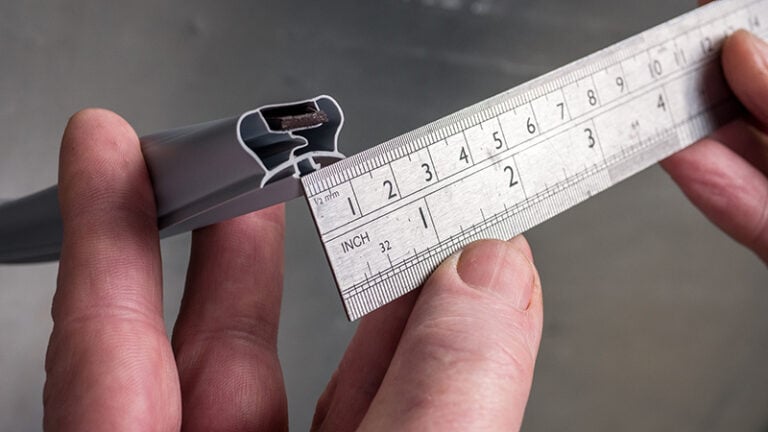
- Identify the profile cross-section. The cross-section of your existing seal determines which profile is required. If the original equipment manufacturer’s profile reference is available (often on an identification plate on the unit or in the documentation), this can be matched directly. If not, the cross-section can be measured and matched against a profile catalogue.
- Measure the gasket. Accurate measurements of the door frame perimeter ensure the replacement is cut to the correct length. For cold room doors, this means measuring all four sides and accounting for any corner joints.
- Confirm the specification. For most standard cold rooms and commercial refrigeration, a standard EPDM compound is the right choice. For freezer applications, confirm the temperature rating. For food production environments, confirm whether a food-grade formulation is required.
For equipment where the profile cannot be identified by reference number, bespoke profiles matched to the existing cross-section can be manufactured and supplied by the metre. The Seal Company can also help you identify your gasket or seal.
Signs that an EPDM cold room seal needs replacing
Even a high-quality EPDM gasket will eventually need replacing. Key indicators are:
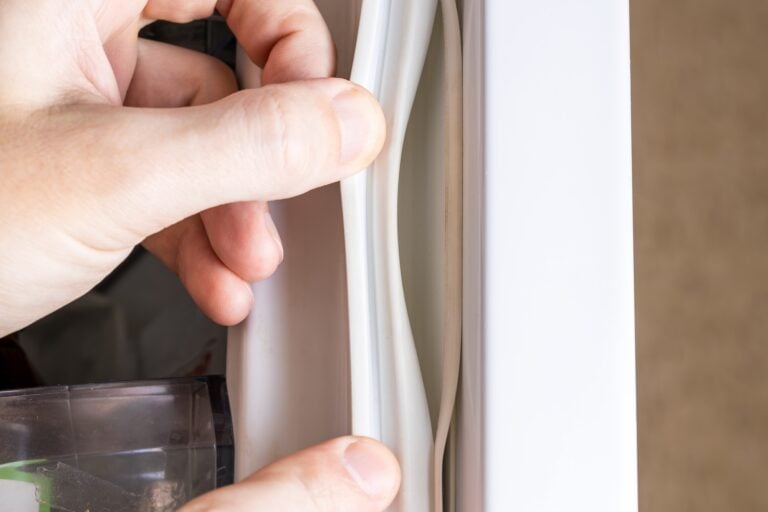
- Visible cracking, splitting, or tearing of the rubber profile, particularly at corners and along the base
- Compression failure: the seal feels hard or does not spring back when pressed
- Frost or ice forming around the door perimeter when the cold room is running
- Mould growth on or behind the gasket, indicating persistent moisture
- Persistent temperature readings above target that cannot be explained by a mechanical fault
- The seal pulling away from the retainer channel or door frame
A gasket that has reached any of these points is no longer sealing correctly. Replacement with a correctly profiled and fitted EPDM gasket restores the airtight barrier and removes the source of the problem.
Ordering EPDM replacement door seals from The Seal Company
The Seal Company supplies EPDM rubber profiles for commercial refrigeration and cold room doors, available by the metre and cut to size. Engineers and trade professionals can register for a business account to access trade pricing. For bespoke requirements or non-standard profiles, our team can advise on cross-section matching and supply.
Whether you are replacing a single cold room gasket or managing a programme of seal replacements across multiple sites, get in touch with The Seal Company for expert advice.
Frequently Asked Questions About EPDM Rubber Door Seals
Can EPDM door seals help reduce energy costs?
Yes. A correctly fitted EPDM door seal can reduce energy costs, because it helps keep cold air inside the unit and warm air out. When a cold room or commercial fridge door does not seal properly, the system has to work harder to maintain temperature. Over time, this can increase energy use, put more strain on refrigeration equipment, and make temperature control less reliable.
Can EPDM seals help prevent condensation and ice build-up?
They can help reduce the conditions that lead to condensation and ice build-up around the door. If warm, moist air is entering through gaps in a damaged or poorly fitted gasket, it can condense or freeze around the door perimeter. Replacing the seal restores a more consistent barrier, although persistent ice or condensation may also point to other issues such as door alignment, damaged hinges, or incorrect operating temperatures.
How should EPDM cold room door seals be cleaned?
EPDM seals should be cleaned regularly with suitable water-based cleaning products, detergents, or sanitisers used in the environment. Avoid petroleum-based cleaners, harsh solvents, or incompatible industrial chemicals, as these can damage the material. Cleaning should also include the folds, corners, and area behind the gasket where moisture and debris can collect.
Can you repair a damaged EPDM door seal, or does it need replacing?
Small surface marks may not affect performance, but splits, tears, hardening, distortion, or sections pulling away from the retainer usually mean the seal should be replaced. A damaged gasket rarely seals evenly, even if only one section looks worn. In commercial refrigeration, replacing the full gasket is usually more reliable than attempting a temporary repair.
How often should EPDM door seals be inspected?
In busy commercial kitchens, food production sites, and high-traffic cold rooms, door seals should be checked regularly as part of planned maintenance. Look for cracking, tearing, hardening, mould, gaps, loose sections, or frost around the door. Regular inspection helps catch seal problems before they affect temperature control, hygiene, or energy use.